

Te Kete Wānaka
Learning, Teaching and Library
Reading more efficiently and critically
What it means to be an efficient and critical reader, why you should be one, and how to read efficiently and critically.

Reading is one of the most important learning activities you will do at university and learning to read efficiently and critically will help you develop your critical thinking skills and achieve more here and beyond.
You will be doing a lot of reading and it's helpful to know techniques and strategies to read effectively. You will need to read both efficiently (ie making decisions about what to read in-depth) and critically (ie the actual in-depth reading).
The flowchart below illustrates a typical read-to-write process with the steps you may take. It shows where reading efficiently and reading critically appear in this whole process.
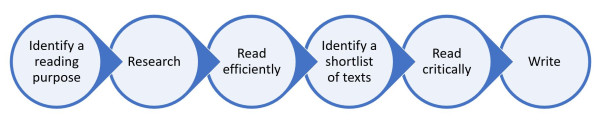
A typical read-to-write process
Before you read
Always approach readings with a purpose and questions in mind.
Think about your purpose, for example, are you reading to get an overall impression, to identify main ideas or to find a specific piece of information?
Then guide your reading by:
- Using learning outcomes from the course outline to form questions about the topic and read to answer these questions.
- Reading the questions at the end of textbook chapters.
- Keep the assessment question in mind if you are reading for an assessment task, and use your plan to guide your reading.
- Having general questions in mind, like 5WH (Who? What? When? Where? Why? How?)
Now that you have a clear purpose for your reading, the next question is how to read efficiently and critically.
Reading efficiently
You can find yourself overloaded with heaps of reading to do. If so, techniques of reading to quickly find what you need will really help. Remember, not everything has to be read carefully and in depth. It's important to learn to use a variety of reading approaches to suit your purpose. Surveying, skimming and scanning will help you understand what an article is about quickly (the author’s purpose, key findings, key conclusions, etc.).
Surveying
- To decide if all or part of the material is worth reading in detail, preview the material (eg look at the title, contents, preface, abstract, index and headings).
Skimming
- To get an “outline” of the content before reading carefully, overview the material (eg read headings, introductory paragraphs, paragraph beginnings, conclusion), or skim
- Look for the key idea in each paragraph – usually at or near the beginning of the paragraph – and check out the evidence that supports this idea
Reading critically
What is reading critically?
If reading efficiently helps you quickly grasp the key information of a reading text, reading critically requires you to slow down and put yourself in an imaginary conversation with the author(s) and/or with the text.
Reading critically is a part of active learning. Instead of simply reading and absorbing the information passively, critical readers interact with what they're reading. They try to make sense of the author’s ideas, compare them with what they already know, analyse the information, decide whether or not they agree with the author, and make questions about the text and their reading of it.
Why should you read critically?
The more you can interpret, analyse and evaluate the texts you read, the more knowledge and insight you will gain about the subject matter. This will improve the quality of the work you do and boost your chances of getting better results for your assessments.
Depending on the level you are at, there might be differences in the examiners’ requirements of the critical reading you should do. However, the common expectations include opinions explained with well-selected evidence from literature, information not just described but analysed, knowledge applied to different contexts and literature critically evaluated.
How can you read critically?
First, reading critically is largely a process of asking questions. To meet the examiners’ expectations, you need to keep the questions below in mind when reading. Remember though that students working in different disciplines may need to think about different types of questions when doing critical reading.
- Relevance: How is the source relevant to my purpose?
- Topics: Does the source introduce me to useful topics to consider?
- Evidence: Does the source mention useful facts, techniques, arguments, opinions, concepts, theories or figures?
- Comparing and contrasting: How is the source similar to and different from other relevant sources?
- Evaluating:
- Do I agree or disagree with the information presented? What are the strengths and weaknesses of the argument?
- How can I combine the information in the source with the material in other sources?
- For my assignments, how can I best organize a discussion of the relevant information?
(Roberts & Hamilton, 2020, p. 48)
Next, reading critically may turn into a time-wasting process if you don’t make notes. This doesn’t mean just underlining or highlighting important passages, copying and pasting chunks of texts that look useful, or even recording key points and your evaluation without any bibliographic information. Instead, making notes means you record your answers to the above questions systematically in preparation for your writing later. Keep a record of your sources as you go for ease of referencing later if these are used in your assessment. There are different strategies available that help you organise and synthesise your notes.
After you read
At the end of the reading task, you can:
- reflect on your reading: Did you find the answers to your questions? What will you do with the information? What new ideas have you found for your writing?
- review your reading purpose, eg in light of the assessment question: What else do you need to read?
References
Roberts, J. Q. & Hamilton, C. (2020). Reading at University: How to improve your focus and be more critical. Macmillan International.