

Te Kete Wānaka
Learning, Teaching and Library
Note making
Learn how to make notes that help you understand and retain information

Note making could be completely new to you, or a skill you would like to improve on. Here you can learn about the note making process, what good notes typically include and common note making methods.
Good note making is not just about making notes in class. It includes referring to wider course materials (PowerPoint slides, readings, videos, quizzes etc) to prepare to get the most out of the class and extend learning beyond it. Even if you have no in-person classes, referring to wider course materials, and not just recorded class videos, will improve your note making.
On this page, discover three strategies for effective note making:
1. Previewing class - to prepare to make higher quality notes
2. Choosing an active note making method for class - to more quickly understand material
3. Reviewing class- to solidify learning and extend or reformat your notes
There is no one right way. Try a combination of the above strategies and see what works for you.
Not knowing anything about the class topic beforehand will make understanding the class difficult. This is because you will be hearing everything for the first time, increasing your cognitive load. You may end up spending all your time taking down notes rather than actively listening to the lecturer.
To help you listen actively and make higher quality notes, become familiar with the topic by previewing the class.
How do I preview lectures?
Do a quick scan of the slides for:
- key topic definitions or the purpose of the class
- key terms that keep repeating
- key examples
- key diagrams
Scan also for the structure of the class (main headings/subheadings) to help you pre-plan your note headings.
Think about how this topic connects to the last class.
Can I use a more extensive previewing strategy?
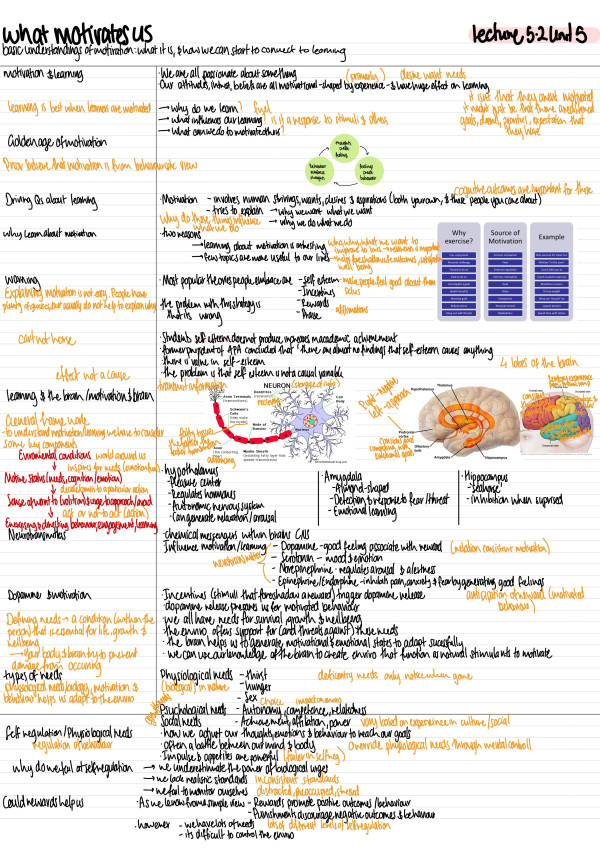
Absolutely! Below is a picture of notes made by Kelly-Anne.
Before class, Kelly-Anne writes outlines in black type. During class, she makes extra, deeper learning notes in orange type. This system allows her to listen more carefully in class and understand everything more quickly, saving study time later.
Can I preview if I have no in person classes?
Yes! You could watch a course instructional video before doing the required reading. The pre-knowledge gained from the video will help your understanding of the reading. Alternatively, it might work better for you to do this the other way round- read the required reading first, then watch the video. This will help you make more informed video notes.
You might want to use Gen AI to get a basic understanding of a tricky concept so you are not starting from scratch. Then go back to the course definition.
What makes a good note making method?
A good note making method will help your understanding because you'll:
- Listen actively to the lecturer
- Order information into main headings, sub-headings and detail
- Rephrase information into your own words, or reformat information into your own diagrams
- Ask questions to find answers to later
- Link to wider information, eg course readings
- Associate theory with examples
- Understand concepts, not just memorise them
- Summarise the key lecture takeaway(s)
- Link new class learning with your previous learning
Can I use Gen AI in class?
Yes. When stuck in class, ask AI to provide you with easier explanations/examples of difficult concepts/definitions. See AI prompt ideas here.
What note making method should I choose?
There are a number note making methods out there. Here are some common ones.
The Cornell method, pictured below, has a space for class note taking (on the right) and a space for making your own comments (on the left). The lefthand column can be used during or after class (or both). It is for questions you are unsure of, definitions in your own words, examples, related course readings etc. The summary space is for the main class takeaway(s).
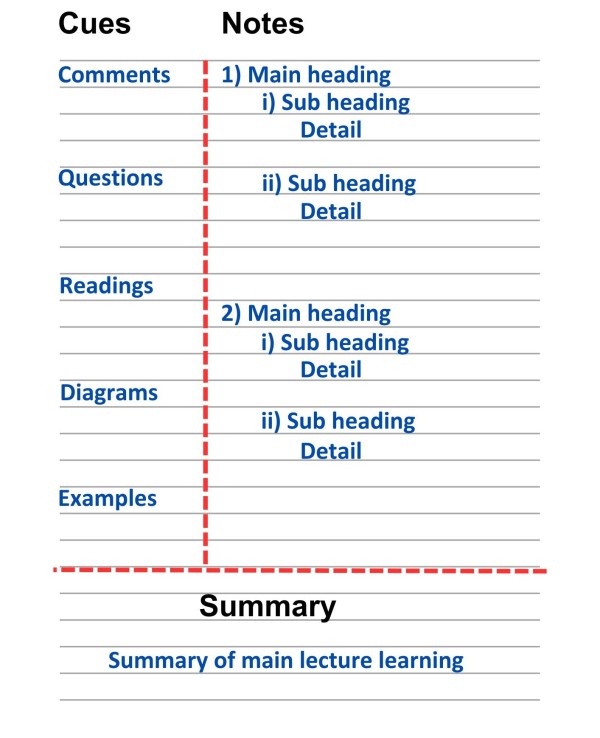
Cornell method of note taking.
Another common note making method is to write notes next to PowerPoint slides. To do this, upload lectures into Microsoft OneNote. During class, write notes next to slides: expanded explanations, examples, definitions in our own words, drawings, questions and so on.
Another note making method is outlining using Microsoft Word. Outlining just means ordering information by headings, subheadings and detail.
Digital tools have the advantage of combining notes in a single location helping you link class notes with other course material.
Watch this short video for other useful note making methods (e.g. mind-mapping or the flow method).
What about pen and paper?
The note making methods above (Cornell, outlining, writing notes next to PowerPoint slides etc) can also be done with pen and paper. It’s up to you! The benefits of paper are drawing pictures, using arrows to link information, creating mind-maps or grouping information flexibly around a page.
There's lots of different ways, choose what suits you and your course material best.
Why should I review class?
Reviewing class stops you from forgetting everything. If your mind recalls class information within 24 hours of the class, or even within the same week, more of that information will be transferred into your long-term memory.
Repetition of studying the same material, over time, is much more effective than cramming.
How do I review class?
Set times in your weekly schedule for review and:
- Test yourself to see if you can recall information.
- Do a quick review of key words, questions, ideas, examples etc.
- Fill out your notes by referring to other course material. Find answers to questions you had in class and do any required readings or quizzes.
- Do something different with your notes than always rewriting them over again. Try being more active with the information.
- test yourself by seeing if you can mind map the four parts of a theory and its subparts
- make a summary sheet
- use highlighters to colour code different kinds of information or underline.
Whatever works for you!
Can study groups help?
Yes! Many students use study buddies or study groups to review class material. StudySMART, peer-led study, may be available in your courses. Go as part of your weekly routine.
Explaining concepts to others helps you process information. Hearing other students explain concepts speeds understanding. Using more senses, like speaking and listening, helps us to remember information.
Can I use a more extensive reviewing strategy?
Yes! If your course has a lot of required readings, try making summary notes that combine your reading notes and class notes. Making combination summaries will extend and deepen your knowledge, as well as help you make links between information.
Preparing for tests and exams
Reformatting class notes is especially important leading up to tests and exams (eg, making summary sheets, mind-maps, cue cards). See Preparing for tests and exams.